120
Robert Rauschenberg
Dietrich Draw
Estimate
$180,000–250,000
Sold For
$140,000
solvent transfer with gouache, pencil and collage on paperboard
15 x 19 7/8 in. (38.1 x 50.5 cm.)
Executed in 1966, this work is registered in the Robert Rauschenberg Foundation archives under number 66.D010.
Full-Cataloguing
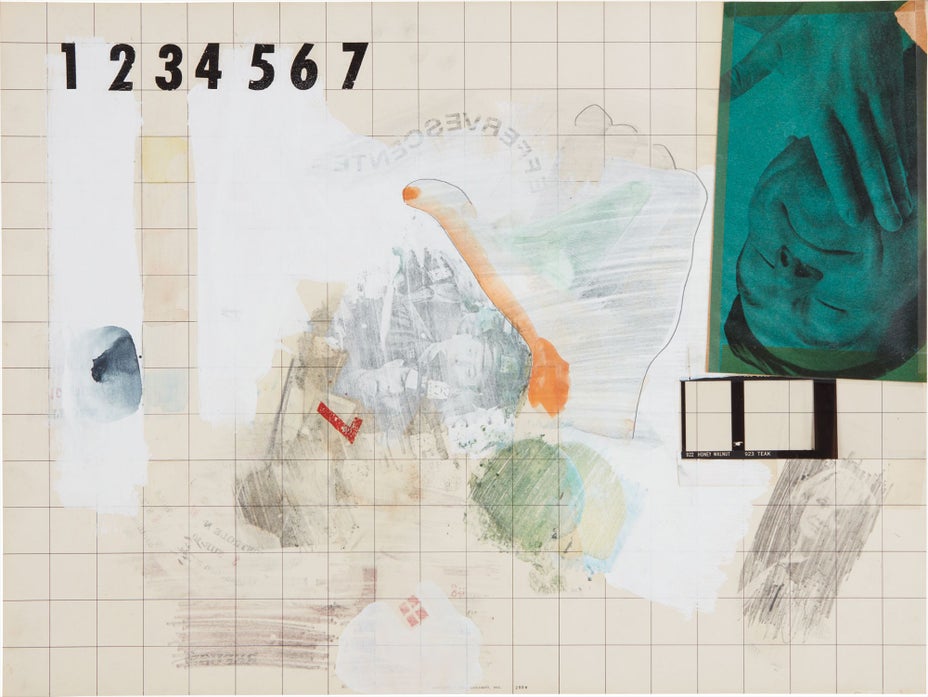
Robert Rauschenberg’s Dietrich Draw is a stellar example of the artist’s renowned transfer drawings, the first of which was executed in 1952. In these works, Rauschenberg takes his characteristic technique of assemblage and applies it to a two-dimensional surface. Created by soaking printed images in a solvent, such as turpentine, and then transferring the image to paper with cross-hatching, the resulting compositions of the transfer drawings are an amalgamation of source imagery, all of which explore a series of nonlinear American narratives. As such, the resulting image exists somewhere outside of the categorizations of painting, drawing and printmaking, being neither entirely mechanized nor hand-produced. In fact, the 1960s marked a departure from the artist’s use of printed mass media imagery found in popular culture in favor of a focus on craft and found materials, a transition which was highlighted in his major retrospective at the Museum of Modern Art this past summer. Dietrich Draw thus represents a unique combination of these two distinct influences, which Rauschenberg was drawing from at this pivotal time.
The present lot is so titled after the famed German American actress and singer Marlene Dietrich, who appears as a transferred image in the lower right quadrant of the composition. Dietrich was celebrated in the United States for her support of German and French exiles during World War II, making her appearance in Rauschenberg’s solvent drawings particularly patriotic, and a tribute to an alternative American hero. Executed circa 1966, the work follows the year when Dietrich received the honorable Israeli Medallion of Valor, making her both the first woman and German to receive the honor. Highly characteristic of Rauschenberg’s most iconic transfer drawings, Dietrich’s ghostly portrait hovers amongst an array of symbols, including a sequence of numbers, text and abstract brushwork, making the present lot one of the artist’s most successful drawings from a critical period in his career.
The present lot is so titled after the famed German American actress and singer Marlene Dietrich, who appears as a transferred image in the lower right quadrant of the composition. Dietrich was celebrated in the United States for her support of German and French exiles during World War II, making her appearance in Rauschenberg’s solvent drawings particularly patriotic, and a tribute to an alternative American hero. Executed circa 1966, the work follows the year when Dietrich received the honorable Israeli Medallion of Valor, making her both the first woman and German to receive the honor. Highly characteristic of Rauschenberg’s most iconic transfer drawings, Dietrich’s ghostly portrait hovers amongst an array of symbols, including a sequence of numbers, text and abstract brushwork, making the present lot one of the artist’s most successful drawings from a critical period in his career.