Property from a Distinguished Private Collection
121
Roy Lichtenstein
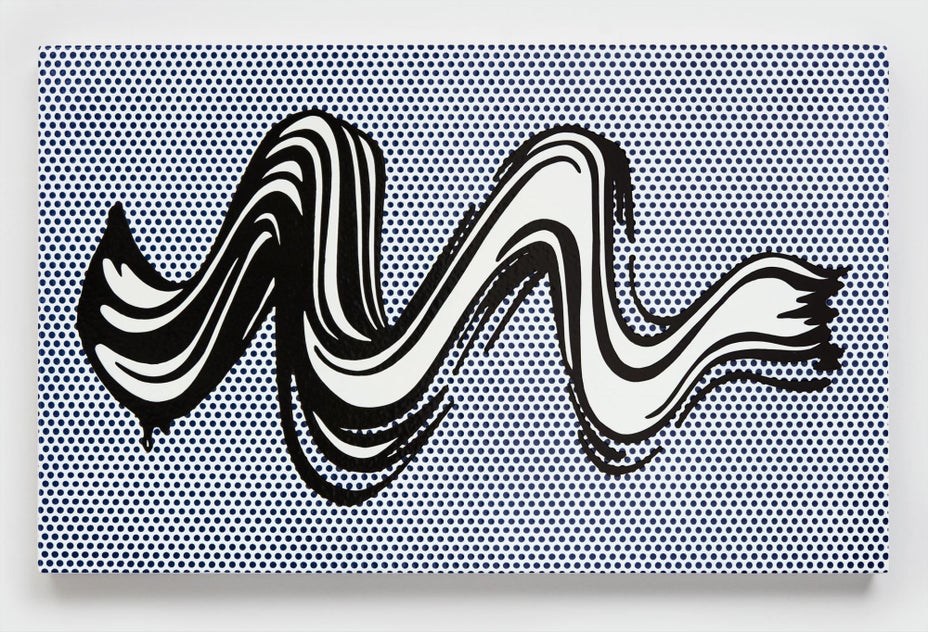
Brushstroke
Estimate
$500,000–700,000
Sold For
$591,000
porcelain enamel on steel
26 1/8 x 42 1/8 in. (66.4 x 107 cm.)
Executed in 1965, this work is number 4 from an edition of 6.
This work will be included in the catalogue raisonné being prepared by The Roy Lichtenstein Foundation and is included in their online works listing.
This work will be included in the catalogue raisonné being prepared by The Roy Lichtenstein Foundation and is included in their online works listing.
Full-Cataloguing
At the onset of the 1960s, Roy Lichtenstein and his Pop contemporaries felt that the avant-garde Abstract Expressionist movement had lost its uniquely contemporary voice. As one of the leading Pop artists of the time, Lichtenstein began looking for ways to challenge the discourse surrounding the masterworks of the previous decades. In 1965, Lichtenstein set out on his first, direct reinterpretation of the Abstract Expressionism of artists like Jackson Pollock and Willem de Kooning in his Brushstroke series, all of which featured one or two brushstrokes, rendered with his characteristic Ben-Day dots. It was in this same first year that the present lot was executed. One from an edition of six created in this pivotal year, Brushstroke is the first early enamel brushstroke work to come to the market in almost a decade, and has remained in the same distinguished private collection for three decades.
In its technique, the present lot belongs to a series of enamel works begun in 1964, inspired by the metal subway signs of New York City with which Lichtenstein was fascinated. In choosing this surface, Lichtenstein aligned himself with his Pop contemporaries who sought out mass media imagery and found objects. Yet, in the subject matter of a single brushstroke, the work completely challenges the traditional notions of painting not only in its surface, but also in its pioneering simplification of the symbol of abstract painting. A singular, cartoon-like brushstroke painted in black and white enters the glossy, ceramic surface on which it rests from the left, extending in what is at once static and full of movement.
The depiction of an active brushstroke, arrested in a sea of midnight blue Ben-Day dots, is particularly evident in the glossy surface of the present lot. As Dave Hickey recalled of the first of Lichtenstein’s brushstrokes created in 1965 and exhibited at Leo Castelli Gallery that same year, “I noticed that the Ben-Day dots, recruited in the service of an abstract image, lost the blowsy, strident vulgarity they had retained in Lichtenstein’s earlier work. They now declared their historical sources in the pointillism of Seurat… they became elegant, well mannered and deeply amusing” (Dave Hickey in Brushstrokes: Four Decades, exh. cat., de Pury & Luxembourg, Zurich, 2002, p. 8). The glistening nature of the subject in this early enamel example is thus not only elegant and amusing, but art historically significant. Following the action painting techniques of his predecessors, Lichtenstein chose to suggest a sense of active movement in a different way. As Diane Waldman espoused, “He caricatured the activity of the brush and the character of the paint as it brushed onto the canvas…Both the figure and its field, however, were bound into the composition by means of the Ben-Day dot…In enlarging the detail, he made a microscopic form carry all of the weight and significance of the macrocosm from which it was born, painting itself.” (Diane Waldman, Roy Lichtenstein, exh. cat., Solomon R. Guggenheim Museum, New York, 1993, p. 157)
Extensively exhibited from the year of its inception and into recent years, examples from the present lot have been shown in both solo and group exhibitions around the globe. One of the first of these exhibitions titled Art in the Mirror, a group show featuring works which reflect art and its place in the world both as a subject and a point of departure, began at the Museum of Modern Art, where an example of this work hung sandwiched between works by his contemporary Robert Rauschenberg and predecessor Marcel Duchamp. This placement among these artists only solidifies Lichtenstein’s importance in the continuous redefinition of art, even at a time when the artist’s renowned brushstroke works were just emerging from his studio. In the accompanying pamphlet for this exhibition, we are reminded of the importance of Lichtenstein’s work in the trajectory of art history: “[the] way to approach art is through the eyes of artists; Rauschenberg may clarify the myth of Leonardo, and Lichtenstein the clichés surrounding Picasso, thereby improving our focus on painting of both the past and the present” (G. R. Swenson, Art in the Mirror, exh. pamphlet, Museum of Modern Art, New York, 1966, n.p.)
In its technique, the present lot belongs to a series of enamel works begun in 1964, inspired by the metal subway signs of New York City with which Lichtenstein was fascinated. In choosing this surface, Lichtenstein aligned himself with his Pop contemporaries who sought out mass media imagery and found objects. Yet, in the subject matter of a single brushstroke, the work completely challenges the traditional notions of painting not only in its surface, but also in its pioneering simplification of the symbol of abstract painting. A singular, cartoon-like brushstroke painted in black and white enters the glossy, ceramic surface on which it rests from the left, extending in what is at once static and full of movement.
The depiction of an active brushstroke, arrested in a sea of midnight blue Ben-Day dots, is particularly evident in the glossy surface of the present lot. As Dave Hickey recalled of the first of Lichtenstein’s brushstrokes created in 1965 and exhibited at Leo Castelli Gallery that same year, “I noticed that the Ben-Day dots, recruited in the service of an abstract image, lost the blowsy, strident vulgarity they had retained in Lichtenstein’s earlier work. They now declared their historical sources in the pointillism of Seurat… they became elegant, well mannered and deeply amusing” (Dave Hickey in Brushstrokes: Four Decades, exh. cat., de Pury & Luxembourg, Zurich, 2002, p. 8). The glistening nature of the subject in this early enamel example is thus not only elegant and amusing, but art historically significant. Following the action painting techniques of his predecessors, Lichtenstein chose to suggest a sense of active movement in a different way. As Diane Waldman espoused, “He caricatured the activity of the brush and the character of the paint as it brushed onto the canvas…Both the figure and its field, however, were bound into the composition by means of the Ben-Day dot…In enlarging the detail, he made a microscopic form carry all of the weight and significance of the macrocosm from which it was born, painting itself.” (Diane Waldman, Roy Lichtenstein, exh. cat., Solomon R. Guggenheim Museum, New York, 1993, p. 157)
Extensively exhibited from the year of its inception and into recent years, examples from the present lot have been shown in both solo and group exhibitions around the globe. One of the first of these exhibitions titled Art in the Mirror, a group show featuring works which reflect art and its place in the world both as a subject and a point of departure, began at the Museum of Modern Art, where an example of this work hung sandwiched between works by his contemporary Robert Rauschenberg and predecessor Marcel Duchamp. This placement among these artists only solidifies Lichtenstein’s importance in the continuous redefinition of art, even at a time when the artist’s renowned brushstroke works were just emerging from his studio. In the accompanying pamphlet for this exhibition, we are reminded of the importance of Lichtenstein’s work in the trajectory of art history: “[the] way to approach art is through the eyes of artists; Rauschenberg may clarify the myth of Leonardo, and Lichtenstein the clichés surrounding Picasso, thereby improving our focus on painting of both the past and the present” (G. R. Swenson, Art in the Mirror, exh. pamphlet, Museum of Modern Art, New York, 1966, n.p.)