37
Robert Mapplethorpe
Self Portrait
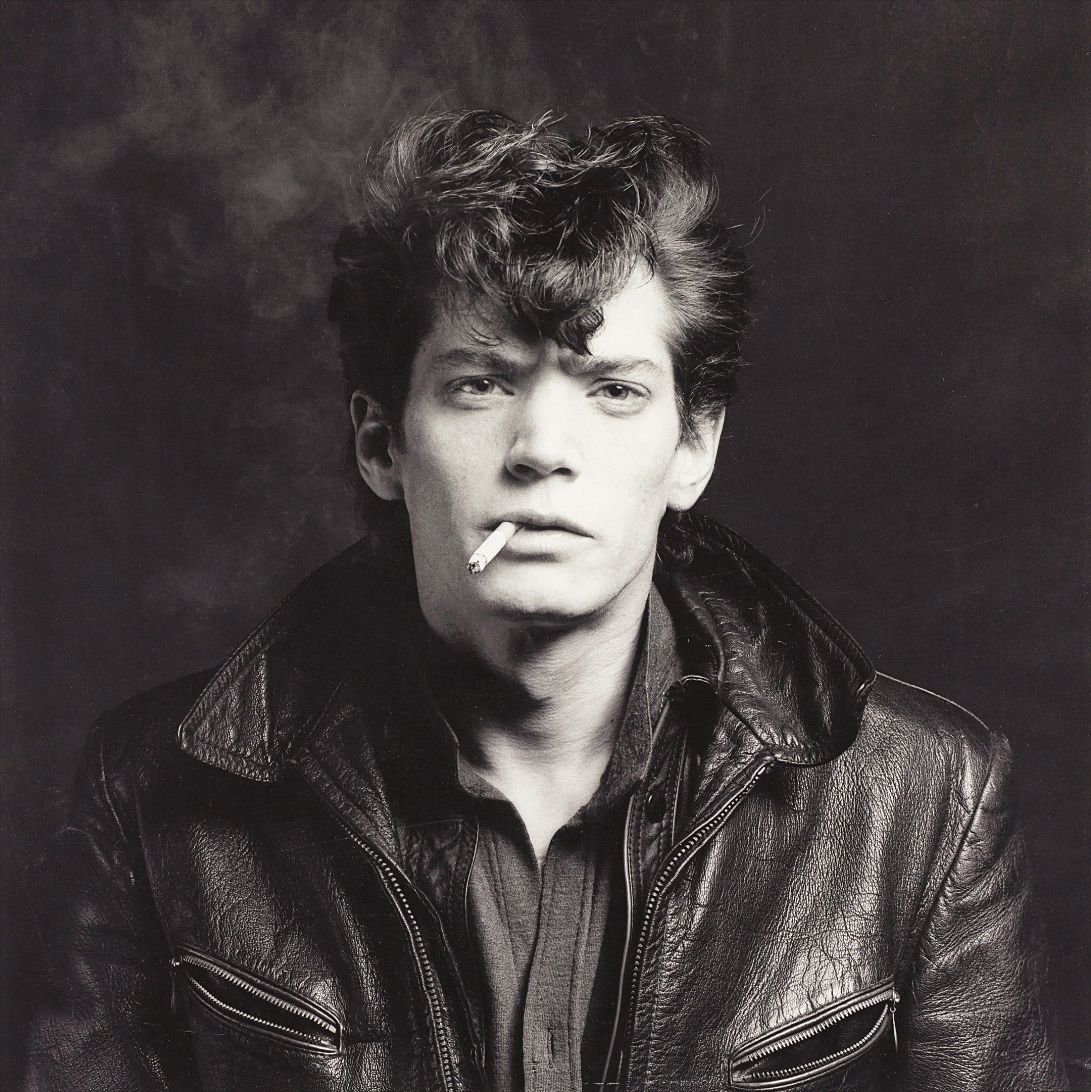
This work is number 2 from the edition of 15 + 3 AP. As of this writing, the other prints from the edition are all held in various collections.
Full-Cataloguing
Susan Sontag
With his 1950s hairdo, the dark leather jacket and a cigarette in the corner of his mouth, Mapplethorpe portrays himself as the quintessential rebel from a bygone era. We immediately are reminded of another cultural icon James Dean and his 1955 flim Rebel Without a Cause. For Certain People, his 1985 book of portraits, Mapplethorpe chose this self portrait for the cover image.
Prints of this image have been acquired by the following institutions: Guggenheim Museum, New York; Museum of Modern Art, New York; The Getty Museum/LACMA, Los Angeles; Walker Art Center, Minneapolis; Tate/National Galleries of Scotland, UK; and Museo Reina Sofía, Madrid. Consistent with other early prints from the edition, this print, numbered ‘2/15’, is signed, dated and numbered in ink by Mapplethorpe in the margin.
Phillips is proud to sponsor the upcoming Robert Mapplethorpe exhibition at the Los Angeles County Museum of Art (LACMA), 20 March – 31 July, 2016. A companion exhibition will be presented concurrently at the J. Paul Getty Museum.
Robert Mapplethorpe
American | B. 1946 D. 1989After studying drawing, painting and sculpture at the Pratt Institute in the 1960s, Robert Mapplethorpe began experimenting with photography while living in the notorious Chelsea Hotel with Patti Smith. Beginning with Polaroids, he soon moved on to a Hasselblad medium-format camera, which he used to explore aspects of life often only seen behind closed doors.
By the 1980s Mapplethorpe's focus was predominantly in the studio, shooting portraits, flowers and nudes. His depiction of the human form in formal compositions reflects his love of classical sculpture and his groundbreaking marriage of those aesthetics with often challenging subject matter. Mapplethorpe's style is present regardless of subject matter — from erotic nudes to self-portraits and flowers — as he ceaselessly strove for what he called "perfection of form."